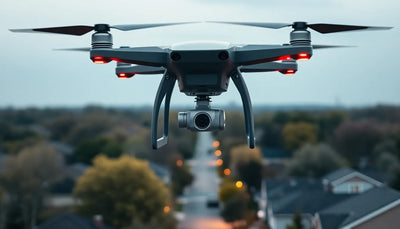
Bellingham Police Run 23 Skydio DFR Flights, Only 1 Incident Response
A public log shows Bellingham police flew 23 Skydio drone-as-first-responder flights since August 19, with one tied to an incident response. The early data raises questions about DFR utilization rates that commercial operators and municipal buyers should watch closely.

Quick answer
Bellingham police have flown 23 Skydio drone-as-first-responder flights since August 19, 2026, with only one logged as an incident response, according to public flight data reported by DroneXL.co.
- The program operates under a $475,417 state grant
- 23 total flights logged since August 19, 2026
- One flight was tied to an incident response
- The remaining flights appear to be training, testing, or non-incident operations
- The public log provides transparency into DFR program activity
Evidence: DroneXL.co
Fleet readiness
Keep DJI hardware available without overbuying new units.
Use defense and fleet news as a planning signal for repair support, inspected pre-owned aircraft, and replacement timing.

Verified facts
What the available evidence confirms
| Metric | Value |
|---|---|
| Program funding | $475,417 state grant |
| Flights logged since Aug. 19 | 23 |
| Incident response flights | 1 |
| Aircraft type | Skydio DFR platform |
Bellingham, Washington has become one of the latest U.S. cities to stand up a drone-as-first-responder program, and the early public flight data is already drawing attention. According to reporting from DroneXL.co, the Bellingham Police Department has logged 23 Skydio DFR flights since August 19, 2026. Of those, just one flight was tied to an incident response.
The program is backed by a $475,417 state grant, a figure that puts Bellingham in line with a growing wave of municipal DFR deployments across the country. But the gap between total flights and actual incident responses highlights a question that fleet managers, municipal buyers, and commercial drone operators should be asking: what does effective DFR utilization actually look like in the first months of a deployment?
What the Bellingham flight log actually shows
The public log cited by DroneXL.co covers a period beginning August 19, 2026. In that window, 23 flights were recorded. One flight was classified as an incident response. The remaining 22 flights were not tied to active incidents, which suggests the department is spending most of its early flight hours on training, system validation, airspace familiarization, and operational testing.
That pattern is not unusual for a new DFR program. Agencies typically need weeks or months to integrate drone operations into dispatch workflows, train pilots, and establish launch protocols before the system becomes a routine part of emergency response. What makes Bellingham notable is the transparency of the log itself. Public flight data gives residents, analysts, and other agencies a window into how quickly a grant-funded program moves from testing to operational response.
For commercial operators watching the public safety market, this early data point matters. It suggests that even well-funded municipal programs take time to convert flight hours into incident responses. Vendors, service providers, and fleet planners should calibrate expectations accordingly when evaluating DFR adoption timelines.
Why DFR utilization rates matter for municipal buyers
Drone-as-first-responder programs are sold on the promise of faster situational awareness, reduced response times, and lower operational costs compared to crewed aviation. But those benefits only materialize when the drone actually launches for incidents. A log showing 23 flights and one incident response raises a straightforward operational question: how many of those flights were necessary preparation, and how many represent underutilization of an expensive asset?
The $475,417 grant figure reported by DroneXL.co is a meaningful public investment. Municipal procurement teams evaluating similar programs should look beyond the headline price and ask vendors for expected flight volume, incident response targets, and training-to-operations ratios during the first 90 days. A program that flies frequently but rarely responds to incidents may still be building capability, but it is not yet delivering the core value proposition of DFR.
Reboot Hub analysis suggests this early-stage utilization pattern is common across U.S. municipal DFR deployments. Agencies often log dozens of test and training flights before the first operational response becomes routine. The key metric to watch is whether the incident response rate climbs steadily over the next two quarters.
What this means for drone owners and the market
For commercial drone operators, the Bellingham data is a reminder that public safety DFR programs are still in an adoption phase rather than a mature operational phase. That has implications for anyone selling services, hardware, or training into the municipal market. Early deployments generate demand for pilot training, airspace coordination, maintenance, and spare parts long before they generate consistent incident response volume.
For individual drone owners and small fleet operators, the public safety push has a secondary effect on the broader market. As agencies like Bellingham police invest in American-made platforms such as Skydio, the competitive landscape for enterprise and government drone procurement shifts. That dynamic can influence resale values, parts availability, and service demand across the wider drone ecosystem. Operators holding pre-owned DJI drones should watch how public sector procurement trends affect the overall health of the commercial drone supply chain. For more context on drone hardware, repair, and ownership considerations, the Drone Wiki offers a practical reference for operators evaluating their equipment and maintenance options. For owners evaluating service and lifecycle risk, Drone Wiki explains the relevant repair, parts, resale, or operational path.
The Bellingham program also reinforces a broader market signal: municipal agencies are willing to commit significant public funds to DFR even when the operational payoff is not immediate. That patience creates a long runway for vendors, integrators, and service providers, but it also raises accountability questions. Public logs like the one in Bellingham will become an increasingly important tool for measuring whether grant-funded drone programs deliver on their promises.
What operators and buyers should watch next
The next three to six months will be telling for Bellingham. If the incident response count remains low relative to total flights, the program may face scrutiny from city officials and residents. If the ratio improves, it will serve as a case study for other mid-sized cities considering DFR adoption.
For fleet managers and procurement teams, the lesson is to build utilization benchmarks into vendor contracts from day one. Ask for transparent flight logging, clear incident response targets, and defined training phases. For repair and maintenance providers, early DFR programs represent a growing customer base, but one that is still finding its operational rhythm.
The Bellingham data is a single data point, not a verdict. But it is a useful reminder that public safety drone programs are measured not by the size of the grant or the sophistication of the platform, but by how often the aircraft actually changes the outcome of an incident.
FAQ
Frequently asked questions
How many flights has the Bellingham police DFR program logged?
According to DroneXL.co reporting on public flight data, the Bellingham Police Department has logged 23 Skydio DFR flights since August 19, 2026.
How many of those flights were incident responses?
One of the 23 logged flights was tied to an incident response. The remaining flights appear to be training, testing, or other non-incident operations.
How much funding did the Bellingham DFR program receive?
The program is supported by a $475,417 state grant, as reported by DroneXL.co.
Which sources support this update?
The visible evidence links identify DroneXL.co; each source is used only for the claim it directly supports.
What remains subject to change?
Retail pricing, availability, product bundles and regulatory timelines can change. Readers should verify the latest terms with the named retailer, manufacturer or regulator before acting.
How should buyers or operators use this analysis?
Use the verified facts as a starting point, then compare mission fit, lifecycle support, maintenance needs and current procurement terms before making a purchase or fleet decision.
Konzultované zdroje
- DroneXL.co - primary source
V době publikování nebyla k dispozici žádná další oficiální dokumentace.
Redakce Reboot Hub poskytuje vlastníkům dronů analýzy nákupů, oprav, prodejní hodnoty a provozu. Pokud narazíte na chybu, kontaktujte nás pro revizi opravy v souladu s našimi redakčními zásadami.