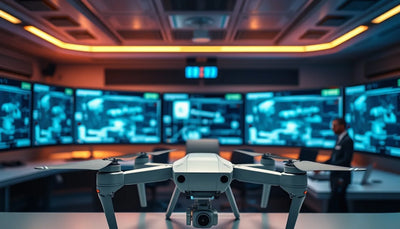
Drone Defense Market Forecast to Hit $18.19 Billion by 2030
A new market report projects the global drone defense system market will reach $18.19 billion by 2030, growing at a 30.6% compound annual rate as security threats intensify for governments, militaries, and critical infrastructure operators.

Quick answer
A ResearchAndMarkets.com report projects the global drone defense system market will reach $18.19 billion by 2030, growing at a 30.6% CAGR, with major players including RTX, Boeing, Lockheed Martin, Northrop Grumman, BAE Systems, and DroneShield scaling AI counter-UAS offerings.
- The drone defense market is forecast to grow from current levels to $18.19 billion by 2030
- The projected compound annual growth rate is 30.6 percent
- Named players include Raytheon Technologies, Lockheed Martin, BAE Systems, and DroneShield
- The report profiles drone-defense offerings, innovations, deployments, and competitive activity
Evidence: Source material · AeroVironment unmanned systems solutions · RTX investor relations · DIU Blue UAS
Fleet readiness
Keep DJI hardware available without overbuying new units.
Use defense and fleet news as a planning signal for repair support, inspected pre-owned aircraft, and replacement timing.

The global drone defense system market is on track to reach $18.19 billion by 2030, according to a market report added to ResearchAndMarkets.com and distributed through GlobeNewswire on October 27, 2026. The report, titled "Drone Defense System Market Global Report 2026," projects a 30.6% compound annual growth rate through the end of the decade as governments and military organizations confront intensifying security threats from unmanned aircraft.
The report profiles major defense contractors and counter-UAS specialists, including Raytheon Technologies, Boeing, Lockheed Martin, Northrop Grumman, BAE Systems, and DroneShield. The coverage spans drone-defense offerings, innovations, deployments, and competitive activity across the sector. For commercial drone operators, fleet managers, and buyers in the pre-owned DJI market, the scale of this projected spending signals a structural shift in how airspace is being secured and regulated around the world.
What the report actually says
The central data point from the ResearchAndMarkets.com report is the $18.19 billion market projection for 2030, paired with a 30.6% compound annual growth rate. That growth rate is exceptionally high for a defense hardware segment, suggesting that counter-UAS procurement is moving from a niche military concern into a broad-based security priority. The report frames this expansion as a response to escalating security threats, though the source summary does not break down spending by region, government agency, or specific deployment scenario.
The named companies reflect the structure of the emerging market. Raytheon Technologies, Lockheed Martin, Northrop Grumman, and BAE Systems represent the traditional defense prime contractor base, while DroneShield stands out as a specialist focused on counter-drone detection and defeat systems. The report profiles each player's drone-defense offerings, innovations, deployments, and competitive positioning, according to the source summary. Reboot Hub analysis: the presence of both prime contractors and dedicated counter-UAS firms suggests the market is maturing into a layered ecosystem rather than a single-vendor category.
Why counter-UAS spending is accelerating now
The report ties the market's exponential growth to intensifying security threats facing governments and military organizations. While the source summary does not enumerate specific incidents, the broader context is well documented across the defense sector: small unmanned aircraft have become cheap, widely available, and difficult to detect with conventional air defense systems. That asymmetry has pushed procurement agencies toward AI-enabled detection, electronic warfare, and kinetic defeat systems.
The mention of AI counter-UAS capabilities in the report title is significant. Traditional radar and radio-frequency jamming systems are increasingly being paired with machine learning algorithms that can distinguish between authorized commercial drones, birds, and hostile platforms. For commercial operators, this matters because the same detection infrastructure being deployed at military bases and critical infrastructure sites is also appearing at airports, stadiums, and urban security perimeters. A drone that is legal to fly in one area may be flagged, tracked, or disrupted in another depending on the local counter-UAS posture.
What this means for drone owners and the market
The projected $18.19 billion counter-UAS market has direct implications for commercial drone owners, even those who never fly near sensitive sites. As defense contractors and security agencies deploy more detection and mitigation systems, the operational environment for legitimate drone flights becomes more complex. Pilots may encounter new radio-frequency interference, expanded no-fly zones, and stricter enforcement of airspace rules in areas that were previously unregulated. Fleet managers planning long-term operations should factor in the possibility that counter-drone infrastructure will expand beyond military installations into civilian critical infrastructure. For owners evaluating service and lifecycle risk, Drone Wiki explains the relevant repair, parts, resale, or operational path.
For buyers in the pre-owned DJI market, the counter-UAS spending wave cuts both ways. On one hand, heightened security awareness can depress demand for used drones in regions where restrictions are tightening or where buyers worry about future flight limitations. On the other hand, the same security scrutiny tends to push commercial operators toward compliant, registered, and well-documented aircraft, which favors sellers who can provide clean ownership histories and verified maintenance records. Operators researching current airspace and equipment considerations may find the Drone Wiki useful for understanding how evolving security measures intersect with commercial drone ownership and repair decisions.
The report's focus on AI-enabled counter-UAS systems also has implications for drone repair and parts demand. As detection systems become more sophisticated, operators may face pressure to ensure their aircraft broadcast proper identification signals, carry updated firmware, and maintain clean radio-frequency profiles. A drone with damaged antennas, outdated transmission components, or non-genuine replacement parts could behave unpredictably in the presence of counter-UAS sensors, increasing the risk of false identification or interference. Professional repair using genuine OEM spare parts becomes more operationally relevant in this environment, not just a matter of performance.
What operators should watch next
The report profiles competitive activity among the major defense players, but the source summary does not provide specific contract awards, deployment locations, or procurement timelines. Operators and industry observers should watch for follow-on announcements from the named companies, particularly around AI detection algorithms, portable counter-UAS systems, and integration with existing air defense networks. DroneShield's inclusion alongside the major prime contractors is notable because it suggests specialist counter-UAS vendors are gaining traction in a market historically dominated by large defense integrators.
Reboot Hub analysis: the 30.6% CAGR projection implies that counter-UAS spending will roughly quadruple over the forecast period if the growth rate holds. That level of investment will inevitably shape airspace policy, insurance requirements, and enforcement practices for commercial drone operations. Fleet managers should monitor regulatory developments in their operating regions and consider how counter-UAS deployments near airports, ports, energy facilities, and government buildings might affect flight planning. Buyers evaluating pre-owned drones should prioritize aircraft with clean compliance histories and documented maintenance, as resale value will increasingly depend on verifiable operational integrity.
The practical takeaway for a commercial drone buyer or fleet manager is straightforward: treat counter-UAS expansion as a planning variable, not a distant military concern. Before purchasing a drone or committing to a long-term operational contract, assess the counter-drone posture in your primary flight areas, confirm that your aircraft can operate cleanly in environments with active detection systems, and keep maintenance records that demonstrate compliance and component integrity. The drone defense market is growing because the airspace is becoming more contested, and operators who plan for that reality will be better positioned than those who ignore it.
This article is market commentary for drone operators and buyers, not investment advice. Reboot Hub does not recommend securities transactions.
FAQ
Frequently asked questions
How large is the drone defense system market projected to become?
The ResearchAndMarkets.com report projects the global drone defense system market will reach $18.19 billion by 2030, growing at a 30.6% compound annual growth rate from current levels.
Which companies are profiled in the drone defense market report?
The report profiles Raytheon Technologies, Boeing, Lockheed Martin, Northrop Grumman, BAE Systems, and DroneShield, covering their drone-defense offerings, innovations, deployments, and competitive activity.
Why should commercial drone operators care about counter-UAS spending?
Expanding counter-UAS deployments can create new interference risks, restricted airspace, and enforcement pressure for commercial pilots, while also increasing the importance of clean compliance histories and documented maintenance for resale value.
Which sources support this update?
The visible evidence links identify Source material and AeroVironment unmanned systems solutions and RTX investor relations and DIU Blue UAS; each source is used only for the claim it directly supports.
What remains subject to change?
Retail pricing, availability, product bundles and regulatory timelines can change. Readers should verify the latest terms with the named retailer, manufacturer or regulator before acting.
How should buyers or operators use this analysis?
Use the verified facts as a starting point, then compare mission fit, lifecycle support, maintenance needs and current procurement terms before making a purchase or fleet decision.
تمت استشارة المصادر
- Source material - primary source
- AeroVironment unmanned systems solutions - official company source
- RTX investor relations - company investor information
- DIU Blue UAS - official government source
تضيف افتتاحية Reboot Hub المشتري والإصلاح وإعادة البيع والتحليل التشغيلي لأصحاب الطائرات بدون طيار. إذا اكتشفت خطأ، فاتصل بنا لمراجعة التصحيح من خلال سياستنا التحريرية.