Volkswagen's China Air Taxi Exit Exposes US Drone Test Infrastructure Gap
Volkswagen's V.MO air taxi project lost China's race not to bans but to competition. The real lesson for US operators: an $8.3 million test range is being built to close an infrastructure gap that affects fleet planning and pre-owned drone values.

The story of Volkswagen's failed V.MO air taxi project in China is not a story about government bans, trade restrictions, or regulatory walls. According to an internal file obtained by Reuters, the German automaker simply lost a competitive footrace. That distinction matters, because the infrastructure gap that contributed to the loss is now being addressed in the United States with an $8.3 million test range—a development that commercial drone operators, fleet managers, and buyers in the pre-owned market should be watching closely.
For years, the narrative around advanced air mobility has been dominated by headlines about which country would regulate faster or which company could secure the most favorable certification pathway. Volkswagen's exit from China's air taxi race reframes the conversation. The company was not pushed out by policy. It was outpaced by rivals who had better access to testing facilities, faster iteration cycles, and a more mature ecosystem for validating new aircraft designs. The lesson for the US drone industry is not about geopolitics; it is about the physical and financial infrastructure required to move from prototype to production.
The competitive loss behind Volkswagen's V.MO exit
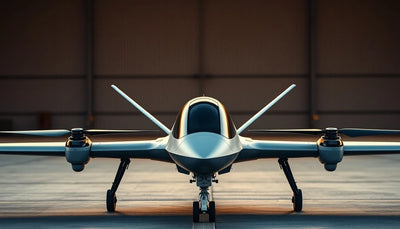
Reuters obtained an internal Volkswagen file detailing why the V.MO air taxi program failed. The document reportedly shows that the project was terminated not because of any external prohibition but because Volkswagen could not keep pace with competitors in China's rapidly consolidating air taxi market. The V.MO, a sleek vertical takeoff and landing concept vehicle, was positioned as a premium urban mobility solution. But in a market where dozens of well-funded startups and established aviation players were iterating on similar designs, Volkswagen lacked the speed and testing capacity to remain viable.
Industrial drone procurement
Source a brand-new industrial drone for this mission.
Discuss mission fit, aircraft model, quantities, configuration, pickup, and lifecycle support with Reboot Hub.

This is a critical detail for commercial drone operators to understand. When a major automotive conglomerate with deep pockets and global engineering resources withdraws from an advanced air mobility program, the cause is rarely a lack of ambition. It is usually a failure of the surrounding support ecosystem. In China, the air taxi race was won by companies that had access to dedicated testing corridors, rapid prototyping facilities, and regulatory sandboxes that allowed them to fly early and often. Volkswagen, an outsider to the aviation industry, could not match that operational tempo.
The practical implication for US drone buyers is straightforward: testing infrastructure is not a back-office concern. It directly influences which aircraft models reach the market, how quickly they mature, and what their long-term reliability looks like. When a major player exits a market segment due to infrastructure limitations, it signals that the remaining players are the ones with superior testing capabilities. For fleet operators, that means the aircraft available for purchase today—whether new or pre-owned—are the products of whichever companies invested early in validation infrastructure.
The $8.3 million test range and what it signals
While Volkswagen was exiting China, the United States was making a different kind of investment. The article highlights an $8.3 million test range being constructed in America, a facility designed to give drone developers a dedicated space to validate their aircraft under controlled conditions. This is not a symbolic gesture. It is a concrete response to the same infrastructure gap that contributed to Volkswagen's failure in China.
For commercial operators, the construction of this test range carries several signals. First, it suggests that US regulators and industry stakeholders recognize that the bottleneck in advanced air mobility is not rulemaking alone—it is the physical capacity to test, fail, and iterate. Second, it indicates that the US drone market is preparing for a wave of new aircraft certifications in the coming years. A test range of this scale is not built for hobbyist quadcopters; it is built for larger, more complex platforms that require significant airspace and ground infrastructure to validate safely.
Reboot Hub analysis: This has direct implications for fleet planning. If the US drone industry is about to see a surge in newly certified aircraft, the value of existing platforms—particularly mature, well-supported models—will shift. Operators who are considering expanding their fleets should pay attention to the certification pipeline. The pre-owned market for DJI drones, for example, is likely to remain robust because these platforms have established reliability records and extensive support networks. New entrants will need to prove themselves in facilities like the $8.3 million test range before they can compete on reliability and lifecycle cost.
What this means for enterprise operators
For enterprise operators, the Volkswagen V.MO story and the US test range investment together point to a practical question: when is it the right time to procure brand-new industrial drone platforms versus relying on proven, pre-owned systems? The answer, based on this news, is that timing depends on mission fit and the maturity of the testing ecosystem behind the aircraft.
Brand-new industrial drone procurement makes sense when a mission requires capabilities that existing platforms cannot deliver. If an operator needs a specific sensor configuration, a unique payload capacity, or a flight endurance profile that is not available in the current market, waiting for a newly certified aircraft may be justified. The construction of dedicated test ranges suggests that such aircraft are in development, and operators with specialized mission requirements should monitor certification announcements closely.
However, for the majority of commercial operations—surveying, inspection, agriculture, logistics—the calculus is different. These missions do not require bleeding-edge air taxi technology. They require reliable, maintainable aircraft with predictable operating costs. In this segment, the infrastructure gap is less about test ranges and more about repair networks, spare parts availability, and documented maintenance histories. Operators who prioritize these factors will find that mature platforms, including inspected pre-owned DJI drones, offer a more favorable risk-adjusted value proposition than unproven new models.
Configuration and quantity decisions should follow the same logic. If an operator is standardizing a fleet of ten aircraft for routine inspection work, the priority is consistency and supportability. A mixed fleet of new and pre-owned units can create maintenance complexity that erodes the cost benefits of either approach. For operators in this position, it is often more practical to acquire a homogeneous fleet of proven platforms with a clear maintenance plan than to chase the latest certification news.
Lifecycle support is the final consideration. The Volkswagen example shows that even well-resourced companies can abandon programs when the ecosystem is not aligned. Operators should apply the same scrutiny to their aircraft suppliers. Before committing to a new platform, ask whether the manufacturer has a demonstrated commitment to long-term support, whether spare parts will be available in five years, and whether the repair ecosystem is mature. If the answer to any of these questions is uncertain, a proven platform with an established support network is the safer commercial choice. For teams translating this development into mission and payload requirements, Reboot Hub's B2B drone procurement service can help scope configuration, fleet quantity, maintenance planning, and lifecycle support before a quotation.
Market implications for pre-owned DJI drones and repair services
The Volkswagen exit and the US test range investment both reinforce a broader market trend: the value of proven, well-supported aircraft is rising. As the advanced air mobility sector consolidates and new entrants must clear higher validation hurdles, the platforms that have already demonstrated reliability in commercial service become more valuable. This is particularly true for the pre-owned DJI market, where aircraft with documented maintenance histories and genuine OEM spare parts availability command a premium.
For buyers considering a pre-owned DJI drone, the key takeaway is to prioritize provenance. A drone that has been flown in commercial service with a complete maintenance log is a different asset than one that has been flown casually without documentation. The former supports fleet planning, insurance underwriting, and predictable repair costs. The latter introduces uncertainty that can undermine the cost savings of buying pre-owned in the first place.
Repair decisions are equally important. As the market for new aircraft evolves, the cost of maintaining existing fleets will become a larger share of total ownership expenses. Operators who invest in professional DJI repair services using genuine OEM spare parts will protect the resale value of their aircraft and extend their useful life. This is not a speculative concern; it is a direct consequence of the infrastructure investments being made in the US drone industry. New aircraft will enter the market, but they will not immediately displace the installed base of proven platforms.
Fleet managers should also consider the timing of their procurement decisions. If the $8.3 million test range accelerates certification of new aircraft, there may be a window where existing platforms are undervalued relative to their remaining useful life. This could present an opportunity for operators to acquire pre-owned DJI drones at favorable prices, provided they have a clear plan for maintenance and eventual replacement. The drone trade-in guide approach—trading in older units when upgrading—becomes more attractive when the market is in transition.
Frequently asked questions
Why did Volkswagen's V.MO air taxi fail in China?
According to an internal file obtained by Reuters, Volkswagen's V.MO air taxi project failed because the company lost a competitive race in China's air taxi market, not because of bans or trade restrictions. Volkswagen was outpaced by rivals with more mature testing and iteration capabilities.
What is the $8.3 million US test range for?
The $8.3 million test range is being built in America to address an infrastructure gap in the US drone industry. It is designed to give drone developers a dedicated facility to validate aircraft under controlled conditions, which is expected to accelerate certification and improve the maturity of new platforms.
How should the Volkswagen news affect my drone purchasing decision?
The news reinforces the value of proven, well-supported aircraft. For most commercial missions, mature platforms with documented maintenance histories and available genuine OEM spare parts offer a better risk-adjusted value than unproven new models. Buyers should prioritize provenance and lifecycle support over chasing the latest certification announcements.
參考來源
- Trump Sons Back Powerus Drone Roll-Up — But the Math Behind 10,000 Drones a Month Doesn’t - primary source
- DJI and SkyPixel Open the 2021 SkyPixel Creative Video Contest - DJI Global or Other Regio - official source
- DroneXL.co - primary reporting source
Reboot Hub 編輯部為無人機所有者提供購買、維修、轉售及營運分析。若發現錯誤,請根據我們的編輯政策聯絡我們進行更正審查。