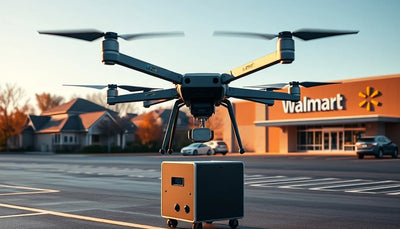
AeroVironment to Build Three Mars Helicopters for NASA 2028 Ice Mission
AeroVironment is working with NASA JPL on three Ingenuity-inspired helicopters for a 2028 Mars mission focused on subsurface ice detection. The announcement moved AVAV shares and signals long-term demand for autonomous aerial systems beyond Earth.

Quick answer
AeroVironment is teaming with NASA JPL to build three Ingenuity-inspired helicopters for a 2028 Mars mission targeting subsurface ice.
- The helicopters are modeled on the Ingenuity design flown on Mars
- The mission is scheduled for 2028
- The goal is to search for ice beneath the Martian surface
- AVAV stock gained following the announcement
Evidence: Source material · AeroVironment unmanned systems solutions
Purchase timing
Use market shifts to buy, sell, repair, or wait with more context.
Compare trade-in timing, pre-owned DJI pricing, and repair economics before committing new capital.

Verified facts
What the available evidence confirms
| Attribute | Detail |
|---|---|
| Company | AeroVironment |
| Partner | NASA Jet Propulsion Laboratory |
| Mission target | Subsurface ice detection |
| Mission year | 2028 |
| Helicopter count | Three |
| Design basis | Ingenuity-inspired |
AeroVironment is expanding its role in planetary aerial robotics. According to a report from Yahoo Finance via Stocktwits, the company is working with NASA's Jet Propulsion Laboratory to build three Ingenuity-inspired helicopters for a 2028 Mars mission. The helicopters are designed to search for ice beneath the Martian surface, a capability that could reshape how scientists and mission planners approach off-world exploration.
The announcement moved AVAV shares higher, reflecting investor interest in a contract that extends AeroVironment's defense and aerospace portfolio into a high-visibility NASA program. For commercial drone operators and fleet buyers, the development is less about immediate product availability and more about what it signals for autonomous aerial system maturity, reliability engineering, and long-term demand for specialized rotorcraft.
The NASA JPL partnership and mission scope
The reported collaboration places AeroVironment alongside NASA's Jet Propulsion Laboratory on a mission scheduled for 2028. The three helicopters are described as Ingenuity-inspired, referencing the original Mars helicopter that demonstrated powered flight on another planet. The mission objective is to hunt for subsurface ice, a resource with scientific and potential operational value for future exploration.
For commercial operators, the technical bar here is instructive. Rotorcraft designed for Mars must operate in an atmosphere roughly one percent as dense as Earth's, with extreme temperature swings and no opportunity for physical maintenance after deployment. That engineering discipline often trickles into terrestrial unmanned systems through improved autonomy, fault tolerance, and lightweight materials. Buyers evaluating enterprise drones should watch how AeroVironment translates these design lessons into its commercial and defense product lines.
Market reaction and what it signals for AVAV
The stock gain reported by Yahoo Finance reflects a broader pattern in the drone and robotics sector: contracts tied to national space programs or defense agencies tend to validate a company's engineering credibility. AeroVironment already maintains a substantial defense portfolio, and the NASA JPL work adds a scientific mission layer that can support long-term revenue visibility.
For fleet operators and procurement teams, the announcement is a reminder that drone manufacturers with diversified revenue streams may be better positioned to sustain R&D through commercial market cycles. Companies that depend on a single product category or a single buyer segment face more volatility. AeroVironment's mix of defense, enterprise, and now planetary science work illustrates a resilience model worth considering when evaluating suppliers.
What this means for drone owners and the market
The Mars helicopter program does not directly change the pre-owned DJI market or repair pricing in the near term. But it does reinforce a broader trend: autonomous aerial systems are moving from experimental demonstrations into mission-critical roles. That shift tends to increase demand for professional maintenance, genuine OEM spare parts, and reliable repair channels across the industry. Operators who treat drones as durable capital assets rather than disposable consumer electronics are better positioned as hardware cycles lengthen and component costs rise.
For buyers and fleet managers, the practical takeaway is to focus on serviceability and parts availability when selecting platforms. As autonomous systems prove themselves in extreme environments, the same reliability expectations will shape commercial procurement. Reboot Hub's Drone Wiki offers reference material for operators evaluating repair, maintenance, and ownership considerations across DJI and other platforms. For owners evaluating service and lifecycle risk, Drone Wiki explains the relevant repair, parts, resale, or operational path.
The AeroVironment news also carries a subtle signal for the second-hand market. When a major manufacturer demonstrates advanced rotorcraft capability, it can reinforce brand confidence and support resale values for its other product lines. While AeroVironment does not compete directly in the consumer DJI space, the overall health of the drone industry affects buyer sentiment across segments. A rising tide of credible autonomous flight applications tends to support demand for inspected pre-owned aircraft and professional repair services.
Long-term implications for autonomous aerial systems
The 2028 Mars mission is years away, but the engineering work begins now. AeroVironment and NASA JPL will need to deliver rotorcraft capable of autonomous operation with no human intervention, no GPS, and no ground crew. Those constraints push the boundaries of onboard processing, sensor fusion, and power management, all of which have direct parallels in terrestrial drone operations.
Commercial operators should expect continued convergence between space-grade autonomy and enterprise drone features. Obstacle avoidance, automated mission planning, and degraded-environment performance are already improving across the industry. The Mars helicopter program accelerates that trajectory by funding research that private companies alone might not pursue. For fleet buyers, this means the next generation of commercial platforms may inherit capabilities first proven on another planet.
This article is market commentary for drone operators and buyers, not investment advice. Reboot Hub does not recommend securities transactions.
FAQ
Frequently asked questions
Is AeroVironment really building Mars helicopters?
According to the Yahoo Finance report, AeroVironment is working with NASA's Jet Propulsion Laboratory to build three Ingenuity-inspired helicopters for a 2028 Mars mission focused on subsurface ice detection.
Why did AVAV stock gain on this news?
Investors responded to the reported NASA JPL collaboration as a positive signal for AeroVironment's aerospace capabilities and long-term revenue potential in autonomous aerial systems.
Does this affect the commercial drone or pre-owned DJI market?
Not directly in the near term. The announcement reinforces broader confidence in autonomous flight technology, which can support demand for professional repair, genuine OEM parts, and inspected pre-owned aircraft across the industry.
Which sources support this update?
The visible evidence links identify Source material and AeroVironment unmanned systems solutions; each source is used only for the claim it directly supports.
What remains subject to change?
Retail pricing, availability, product bundles and regulatory timelines can change. Readers should verify the latest terms with the named retailer, manufacturer or regulator before acting.
How should buyers or operators use this analysis?
Use the verified facts as a starting point, then compare mission fit, lifecycle support, maintenance needs and current procurement terms before making a purchase or fleet decision.
Konzultované zdroje
- Stocktwits retail trader market report - primary source
- AeroVironment investor relations - company investor information
Redakce Reboot Hub poskytuje vlastníkům dronů analýzy nákupů, oprav, prodejní hodnoty a provozu. Pokud narazíte na chybu, kontaktujte nás pro revizi opravy v souladu s našimi redakčními zásadami.
Tento článek je tržním komentářem pro provozovatele a kupce dronů, nikoli investičním poradenstvím. Reboot Hub neposkytuje finanční poradenství ani nedoporučuje transakce s cennými papíry.