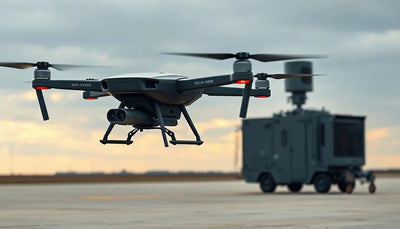
DJI Matrice 400 Gains Autonomous Dock Option in Canada
A Canada-focused launch pairs the DJI Matrice 400 with an autonomous docking station, narrowing the long-standing gap between heavy-lift capability and remote automated operations for commercial drone fleets.

Quick answer
A new product launching in Canada pairs the DJI Matrice 400 with an autonomous drone dock, targeting enterprise operators who previously had to choose between heavy-lift capability and dock-based automation.
- Reported by DroneDJ on August 31, 2026
- Aims to combine heavy-lift sensor capacity with autonomous dock operations
- Targets enterprise operators in Canada
- Addresses a long-standing trade-off between power and automation
Evidence: DroneDJ
Industrial drone procurement
Source a brand-new industrial drone for this mission.
Discuss mission fit, aircraft model, quantities, configuration, pickup, and lifecycle support with Reboot Hub.

For years, enterprise drone buyers have faced a persistent structural trade-off. Aircraft capable of carrying advanced sensors such as LiDAR, thermal cameras, and high-zoom payloads have typically required a crew on-site to launch, land, swap batteries, and manage flights. Meanwhile, drones that could operate from autonomous docking stations have generally been smaller, lighter platforms with more limited payload capacity. A new product launching in Canada aims to close that gap by pairing the DJI Matrice 400 with an autonomous drone dock, according to a report published by DroneDJ on August 31, 2026.
The development matters because it targets a specific operational pain point: remote and repeatable heavy-lift missions. Utilities, energy companies, survey firms, and infrastructure operators have long wanted persistent aerial coverage without stationing personnel at every site. If the reported dock integration performs as intended, it could shift how fleet managers think about deploying larger DJI aircraft in semi-autonomous or remote workflows.
What the reported launch actually changes
DroneDJ reports that the new product launching in Canada is designed to let the DJI Matrice 400 operate from a docking station, a configuration that has historically been associated with smaller enterprise platforms. The report frames this as a response to a long-standing market gap: operators who wanted heavy-lift capability usually accepted manual on-site operations, while operators who wanted dock-based automation usually accepted smaller aircraft and fewer sensor options.
The practical significance is not just about hardware. It is about mission cadence. A dock-capable heavy-lift platform could support scheduled inspections, repeat mapping flights, or remote monitoring without a pilot physically present at the launch point. For fleet operators managing assets across wide geographic areas, that changes labor planning, travel costs, and the speed at which data can be collected.
Reboot Hub analysis: the commercial value of this kind of integration depends heavily on reliability, weather tolerance, and maintenance burden. Docks introduce moving parts, charging systems, and environmental sealing requirements that do not exist in manual operations. Buyers should treat the dock as a second system to maintain, not simply an accessory for the aircraft.
What this means for enterprise operators
For enterprise operators, the reported launch signals that the heavy-lift and automation segments are beginning to converge. A fleet manager who previously ruled out dock-based operations because the available aircraft could not carry the required sensors may now have a reason to revisit that assumption. The Matrice 400 is a platform associated with demanding commercial payloads, and the prospect of automating its deployment could reduce the marginal cost of frequent, repeatable missions. For teams translating this development into fleet planning, Enterprise drone procurement support helps scope mission fit, unit quantity, maintenance coverage, and lifecycle support.
The operational question is whether the dock can reliably handle the aircraft over time. Docking systems must manage battery charging, environmental exposure, and mechanical wear across hundreds or thousands of cycles. For buyers evaluating this category, the total cost of ownership includes dock servicing, spare parts, and potential downtime when the docking mechanism requires repair. That is where procurement planning and genuine OEM spare parts availability become material to the decision. Operators considering a dock-enabled Matrice 400 deployment should evaluate long-term support pathways before committing fleet budget, and enterprise buyers building mixed fleets can use Enterprise drone procurement support to compare platform and support costs across the ownership cycle.
There is also a workforce implication. Dock-based operations change the role of the pilot from hands-on aircraft handler to remote mission supervisor. That shift can reduce travel and on-site labor, but it also requires different training, procedures, and contingency planning. A dock failure at a remote site is not the same as a failed manual launch, because there may be no technician nearby to intervene.
Pre-owned DJI market and fleet planning implications
Product launches like this tend to ripple through the pre-owned DJI market in two directions. First, operators who adopt the new dock-enabled configuration may rotate older heavy-lift aircraft out of active service, increasing the supply of inspected pre-owned DJI platforms in the secondary market. Second, buyers who do not need dock automation immediately may find value in acquiring pre-owned Matrice-class aircraft at a lower entry cost while the new integration matures.
For repair and parts planning, the introduction of a dock ecosystem adds a new category of components that will eventually need servicing. Docking stations contain actuators, charging hardware, and environmental seals that wear over time. Fleet managers should anticipate that dock maintenance will become a recurring line item, separate from aircraft airframe and sensor upkeep. Genuine OEM spare parts availability for both the aircraft and the dock will influence long-term operating costs.
The pre-owned market impact is still speculative at this stage. The reported launch is specific to Canada, and broader availability has not been confirmed in the source material. Buyers should avoid making procurement decisions based on a single regional announcement. Instead, treat this as a signal that the heavy-lift automation segment is advancing, and plan fleet refreshes accordingly.
What buyers and fleet managers should watch next
The most important next step is verification of real-world performance. The DroneDJ report describes a product launch, not independent testing data. Buyers should look for operator feedback on dock reliability, charging cycle performance, weather limits, and integration with existing flight planning software before committing capital. A dock that works in a controlled demonstration may behave very differently in a remote utility corridor or coastal industrial site.
Procurement teams should also consider how a dock-enabled Matrice 400 fits into existing workflows. The value proposition is strongest where missions are frequent, repeatable, and geographically dispersed. For one-off surveys or projects with irregular flight schedules, the added cost and maintenance burden of a dock may not be justified. The decision should be driven by mission frequency and labor cost, not by the novelty of the automation.
For repair customers and parts buyers, the practical takeaway is to monitor how the dock ecosystem develops. If the integration gains traction, demand for dock-specific components and servicing expertise will follow. Operators who already run Matrice-class aircraft should keep their current platforms airworthy while the new system proves itself in the field.
FAQ
Frequently asked questions
What did DroneDJ report about the DJI Matrice 400?
DroneDJ reported on August 31, 2026, that a new product launching in Canada pairs the DJI Matrice 400 with an autonomous drone dock, aiming to combine heavy-lift capability with dock-based automation.
Why does this matter for enterprise drone operators?
It matters because enterprise operators have historically had to choose between heavy-lift aircraft requiring on-site crews and smaller dock-capable drones with limited payloads. The reported integration could enable remote, repeatable missions with larger sensor payloads.
Should fleet managers change procurement plans based on this report?
Not immediately. The report describes a regional product launch without independent performance data. Fleet managers should monitor real-world reliability, dock maintenance costs, and broader availability before making procurement decisions.
Which sources support this update?
The visible evidence links identify DroneDJ; each source is used only for the claim it directly supports.
What remains subject to change?
Retail pricing, availability, product bundles and regulatory timelines can change. Readers should verify the latest terms with the named retailer, manufacturer or regulator before acting.
How should buyers or operators use this analysis?
Use the verified facts as a starting point, then compare mission fit, lifecycle support, maintenance needs and current procurement terms before making a purchase or fleet decision.
Konzultált források
- DroneDJ - primary source
- DIU Blue UAS - official government source
A Reboot Hub szerkesztősége vásárlási, javítási, viszonteladási és üzemeltetési elemzéseket nyújt dróntulajdonosok számára. Ha hibát észlel, kérjük, jelezze nekünk a szerkesztői irányelvünknek megfelelően a javítás érdekében.
Ez a cikk piaci elemzés drónüzemeltetők és vevők számára, nem jelent befektetési tanácsot. A Reboot Hub nem nyújt pénzügyi tanácsadást és nem javasol értékpapír-tranzakciókat.