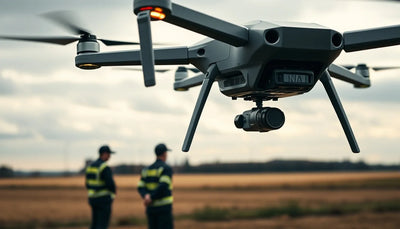
BRINC iOS App Brings Live Public Safety Drone Feeds to iPhones
BRINC launched an iOS app that streams live public safety drone feeds and operational data to iPhones and iPads, removing the command center bottleneck for first responders. The shift signals broader mobile fleet visibility for agencies and commercial operators evaluating hardware and workflow investments.

Quick answer
BRINC launched an iOS app that brings live drone feeds, operational data, and airspace awareness to iPhones and iPads for first responders, according to DroneDJ reporting.
- First responders can view agency drone feeds without being inside a command center
- The app delivers live video, operational data, and airspace awareness on Apple mobile devices
- The development reflects broader demand for mobile fleet visibility in public safety operations
- Commercial operators should watch how mobile command workflows influence hardware and software procurement
Evidence: DroneDJ
Industrial drone procurement
Source a brand-new industrial drone for this mission.
Discuss mission fit, aircraft model, quantities, configuration, pickup, and lifecycle support with Reboot Hub.

Public safety drone operations have traditionally tied live video and telemetry to fixed command posts, vehicle-mounted displays, or dedicated controller screens. That constraint shaped how agencies staffed incidents, how pilots coordinated with incident commanders, and how quickly aerial intelligence reached decision-makers in the field. According to reporting from DroneDJ, BRINC has now moved to loosen that tether with a new iOS application that puts live drone feeds and operational data directly on iPhones and iPads.
The reported launch means first responders no longer need to be sitting inside a command center to see what their agency's drones are seeing. DroneDJ describes the app as bringing live drone feeds, operational data, and airspace awareness to Apple mobile devices. For fleet operators and procurement teams watching the public safety segment, the development is a signal about where mobile command workflows are heading, not just a single vendor's product update.
What the BRINC iOS app reportedly delivers
DroneDJ's reporting indicates the new iOS application is designed to extend situational awareness beyond the physical command post. The source describes three core capabilities: live drone feeds, operational data, and airspace awareness delivered to iPhones and iPads. That combination matters because it suggests the app is not simply a video player but a lightweight command interface for field personnel.
The practical implication is straightforward. An incident commander, supervisor, or responding officer can pull up a live aerial view on a device they already carry, rather than waiting for a feed relayed through a dispatcher or a fixed console. For agencies that run multiple drones across a scene, mobile access to operational data could reduce coordination delays and improve how aerial intelligence is shared across teams. Reboot Hub analysis suggests this type of mobile-first workflow may accelerate refresh cycles for agency-owned hardware, since older devices and controllers without robust connectivity features become less attractive as software expectations rise.
What this means for enterprise operators
For commercial fleet managers and enterprise buyers, the BRINC announcement is less about a single app and more about the direction of operational software. Public safety agencies are among the most demanding drone customers. They require reliable live video, clear chain-of-custody for evidence, and tools that work under pressure. When a vendor in that segment prioritizes mobile access, it often previews features that later become standard in adjacent commercial markets such as inspection, security, and logistics.
Buyers evaluating drone platforms should pay attention to how much of the operational workflow lives on the controller versus how much can be distributed across mobile devices. A fleet that depends on a single pilot screen creates a bottleneck. A fleet that can push live feeds and telemetry to multiple authorized devices creates more flexible staffing and faster decision-making. For organizations planning multi-year procurement cycles, software capability is becoming as important as airframe specifications. Teams managing mixed fleets may also want to review how their existing hardware integrates with mobile command tools before committing to new purchases. For organizations navigating hardware transitions, Enterprise drone procurement support can help align fleet decisions with current operational software expectations. For teams translating this development into fleet planning, Enterprise drone procurement support helps scope mission fit, unit quantity, maintenance coverage, and lifecycle support.
The pre-owned DJI market may also feel a subtle effect. As mobile command software becomes more common in professional segments, demand shifts toward airframes and controllers that support clean integration with third-party and first-party mobile tools. Older pre-owned DJI models that lack robust connectivity or software support may see softer resale interest from commercial buyers, while newer inspected pre-owned units with stronger ecosystem compatibility could hold value better. Fleet managers planning partial refreshes should factor software longevity into their buy-versus-hold calculations.
Why mobile command access changes procurement thinking
DroneDJ's report frames the BRINC app as a public safety tool, but the underlying logic applies broadly. Agencies and enterprises do not buy drones in isolation. They buy workflows. A drone that requires a dedicated operator at a fixed console has different staffing and training costs than one that can be monitored from a phone carried by a field supervisor. When software reduces the need for physical presence at a command center, it changes how many people need to be trained, where they can be located, and how quickly aerial data reaches the person making decisions.
For repair and maintenance planning, mobile command tools also introduce a new dependency. If field personnel rely on an app for live feeds, then software updates, device compatibility, and connectivity troubleshooting become part of the operational support burden. Agencies and companies should ask vendors how mobile applications are maintained, how often they are updated, and what happens when a device operating system changes. These are the same questions fleet managers ask about firmware, but now they extend to the phones and tablets in the field.
There is also a security dimension that source-limited reporting cannot fully resolve. DroneDJ's summary does not detail encryption, authentication, or data handling for the new app. Buyers in regulated sectors should treat those details as open questions and request documentation before adopting any mobile command tool for sensitive operations. The absence of confirmed security specifications in the source should not be read as a flaw, but it does mean procurement teams need to do their own verification.
What buyers and fleet managers should watch next
The BRINC iOS app is one data point in a broader shift toward distributed drone operations. Buyers should watch whether other public safety and enterprise drone vendors follow with similar mobile capabilities, and whether agencies begin writing mobile access requirements into procurement documents. If mobile command access becomes a standard checklist item, it will influence which platforms win public sector contracts and which older systems lose relevance.
Fleet managers should also consider how mobile access affects pilot staffing. If a supervisor can monitor a live feed from a phone, the pilot can focus on aircraft control while the supervisor handles scene assessment. That division of labor can improve safety and efficiency, but it requires clear protocols about who has authority to direct the flight. Software alone does not solve command structure; it simply gives more people a window into the operation.
For repair customers and second-hand buyers, the takeaway is to evaluate ecosystem health, not just airframe condition. A drone that flies well but cannot integrate with current mobile command tools may cost more in workflow friction than it saves in purchase price. Inspected pre-owned DJI units with current firmware and strong accessory support remain a practical entry point for operators who need reliable hardware without overcommitting to a single vendor's software stack.
FAQ
Frequently asked questions
What did BRINC announce?
According to DroneDJ, BRINC launched a new iOS app that brings live drone feeds, operational data, and airspace awareness to iPhones and iPads for first responders.
Why does mobile drone command access matter for fleet operators?
Mobile access removes the requirement to be at a fixed command center to view live aerial feeds, which can reduce coordination delays and allow supervisors to make faster decisions from the field.
How could this affect pre-owned DJI drone demand?
As mobile command software becomes more common, commercial buyers may favor pre-owned DJI units with stronger ecosystem compatibility and current software support, while older models with limited connectivity could see softer resale interest.
Which sources support this update?
The visible evidence links identify DroneDJ; each source is used only for the claim it directly supports.
What remains subject to change?
Retail pricing, availability, product bundles and regulatory timelines can change. Readers should verify the latest terms with the named retailer, manufacturer or regulator before acting.
How should buyers or operators use this analysis?
Use the verified facts as a starting point, then compare mission fit, lifecycle support, maintenance needs and current procurement terms before making a purchase or fleet decision.
Konzultált források
- DroneDJ - primary source
A közzététel időpontjában további hivatalos dokumentáció nem állt rendelkezésre.
A Reboot Hub szerkesztősége vásárlási, javítási, viszonteladási és üzemeltetési elemzéseket nyújt dróntulajdonosok számára. Ha hibát észlel, kérjük, jelezze nekünk a szerkesztői irányelvünknek megfelelően a javítás érdekében.