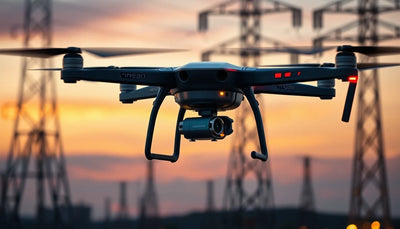
DJI Matrice 5T Launch Pairs Thermal Imaging With Longer Flight Time
DJI has introduced the Matrice 5T, a compact enterprise drone aimed at public safety, infrastructure inspection, and surveying. The launch pairs thermal imaging, AI-driven automation, and up to 59 minutes of flight, though U.S. availability remains uncertain.

Quick answer
DJI has launched the Matrice 5T, a compact enterprise drone combining thermal imaging, onboard AI, obstacle detection, and up to 59 minutes of flight time for public safety, infrastructure inspection, and surveying.
- Targeted at public safety, infrastructure inspection, and surveying workflows
- Combines thermal imaging, AI, and built-in obstacle detection
- Advertised flight time reaches up to 59 minutes
- U.S. availability remains uncertain according to DRONELIFE reporting
Evidence: DRONELIFE
Industrial drone procurement
Source a brand-new industrial drone for this mission.
Discuss mission fit, aircraft model, quantities, configuration, pickup, and lifecycle support with Reboot Hub.

DJI has launched the Matrice 5T, a compact enterprise drone positioned for public safety, infrastructure inspection, and surveying. The announcement, reported by DRONELIFE on November 5, 2026, describes an aircraft that combines high-resolution thermal imaging, built-in obstacle detection, and onboard AI with a flight time of up to 59 minutes.
The launch is notable less for a single headline feature than for the way it bundles thermal capability, automation, and endurance into a smaller enterprise airframe. For commercial operators and fleet buyers, that combination matters because it suggests a platform designed around recurring inspection and response workflows rather than one-off mapping jobs. The open question is whether U.S. customers will be able to buy it at all.
What the launch actually includes
According to the DRONELIFE report, the Matrice 5T brings together three operational capabilities: high-resolution thermal imaging for low-light and heat-sensitive work, advanced obstacle detection for safer flight in complex environments, and onboard AI intended to support automated workflows. The aircraft is described as compact, which positions it below larger enterprise platforms in terms of footprint while still targeting serious commercial use cases.
The advertised flight time of up to 59 minutes is a meaningful number for inspection teams. Longer endurance reduces the number of battery swaps during a shift and can make a single flight cover more linear infrastructure, a larger survey area, or a longer public safety response window. However, the source does not provide independent verification of that figure, and real-world endurance typically varies with payload, weather, and flight profile. Operators should treat the 59-minute figure as a manufacturer-reported ceiling rather than a guaranteed field number.
The thermal imaging component is the most commercially significant element for buyers who already run visual-only enterprise drones. Thermal sensors expand the addressable workload to night operations, heat-loss inspection, search and rescue, and electrical or mechanical fault detection. For fleet managers, a single airframe that handles both visual and thermal tasks can simplify training, spares planning, and maintenance scheduling compared with running separate specialized platforms.
What this means for enterprise operators
For U.S.-based enterprise operators, the most important detail in the DRONELIFE report may be the uncertainty around domestic availability. The source explicitly notes that U.S. availability remains uncertain, and the report does not cite a confirmed U.S. launch date, pricing, or distribution channel. That uncertainty has practical consequences. A fleet manager evaluating the Matrice 5T today cannot assume it will be obtainable through normal U.S. dealer channels, and procurement timelines should account for that risk. For teams translating this development into fleet planning, Enterprise drone procurement support helps scope mission fit, unit quantity, maintenance coverage, and lifecycle support.
Reboot Hub analysis: The uncertainty also flows into the pre-owned DJI market. When a new enterprise platform is announced but not confirmed for U.S. sale, some operators hold off on replacing existing equipment, while others accelerate purchases of current-generation models that are already proven and available. For buyers considering inspected pre-owned DJI aircraft, that dynamic can work in both directions: supply may tighten if operators delay fleet turnover, or it may loosen if early adopters sell current models in anticipation of an upgrade. Reboot Hub analysis suggests that until U.S. availability is clarified, the pre-owned market for existing DJI enterprise platforms is likely to remain the more predictable procurement path for domestic buyers. For teams that need a dependable enterprise drone now, Enterprise drone procurement support can help evaluate available platforms and parts without waiting on an unconfirmed launch.
There is also a repair and parts consideration. New airframes with onboard AI and integrated thermal payloads tend to concentrate more value in fewer components. If a thermal sensor or obstacle-detection module fails, repair costs can be higher than on a simpler visual platform. Operators who eventually adopt the Matrice 5T should budget for genuine OEM spare parts and professional service rather than assuming field-replaceable modules will be inexpensive or widely stocked.
Commercial positioning and market context
DJI continues to push its enterprise line toward integrated, AI-assisted platforms rather than raw flight hardware. The Matrice 5T fits that pattern: the selling proposition is not just a drone with a thermal camera, but a workflow tool with obstacle detection and automated task support. For public safety agencies, that means fewer manual flight inputs during time-sensitive operations. For infrastructure inspectors, it means more consistent data collection across repeat visits to the same asset.
That positioning has implications for how buyers evaluate the platform. A procurement team should not compare the Matrice 5T to a consumer thermal drone or a visual-only enterprise aircraft on price alone. The relevant comparison is total cost per completed inspection or response mission, including flight time, automation reliability, sensor quality, and repair downtime. On that basis, the Matrice 5T appears aimed at organizations that run frequent, structured missions rather than occasional ad-hoc flights.
The source does not provide pricing, sensor resolution details, or specific AI workflow examples, so Reboot Hub cannot assess how the Matrice 5T stacks up against competing enterprise thermal platforms on a specification basis. Buyers should request full technical documentation and, where possible, hands-on evaluation before committing fleet budgets.
What buyers and fleet managers should watch next
The immediate next step for U.S. operators is to monitor whether DJI confirms domestic availability and through which channels. Until that happens, the Matrice 5T is a product announcement rather than a procurement option. Fleet managers with near-term inspection or public safety requirements should continue evaluating platforms that are actually available in their region, including current-generation DJI enterprise aircraft and inspected pre-owned units backed by genuine OEM parts and professional repair support.
For operators outside the U.S., the launch may be more immediately actionable. Teams in regions where DJI enterprise products are distributed normally can begin assessing whether the Matrice 5T's thermal capability and endurance justify a fleet addition or replacement. The key evaluation points are mission duration, thermal image quality in real operating conditions, and the reliability of the obstacle-detection system in the environments where the aircraft will actually fly.
One practical takeaway applies regardless of region: do not anchor a fleet decision to a single manufacturer-reported flight time. Test endurance under your own payload and weather conditions, confirm thermal performance on the specific targets you inspect, and understand parts availability before committing. A drone that cannot be repaired quickly is a liability, not an asset.
FAQ
Frequently asked questions
Is the DJI Matrice 5T available in the United States?
According to DRONELIFE reporting, U.S. availability remains uncertain. The source does not confirm a U.S. launch date, pricing, or distribution channel.
What is the Matrice 5T designed for?
DJI positions the Matrice 5T for public safety, infrastructure inspection, and surveying, with thermal imaging, obstacle detection, and onboard AI supporting those workflows.
How long can the Matrice 5T fly?
DJI reports up to 59 minutes of flight time, though real-world endurance will vary with payload, weather, and flight profile.
Which sources support this update?
The visible evidence links identify DRONELIFE; each source is used only for the claim it directly supports.
What remains subject to change?
Retail pricing, availability, product bundles and regulatory timelines can change. Readers should verify the latest terms with the named retailer, manufacturer or regulator before acting.
How should buyers or operators use this analysis?
Use the verified facts as a starting point, then compare mission fit, lifecycle support, maintenance needs and current procurement terms before making a purchase or fleet decision.
Fuentes consultadas
- DRONELIFE - primary source
No había documentación oficial adicional disponible al momento de la publicación.
Reboot Hub Editorial ofrece análisis de compra, reparación, reventa y operatividad para propietarios de drones. Si detecta algún error, contáctenos para solicitar una revisión de corrección conforme a nuestra política editorial.