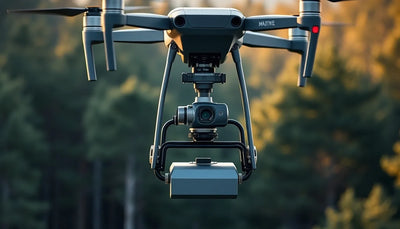
DJI Dock 4 Launches With 25-Second Automated Battery Swaps
DJI has introduced the Dock 4, an automated drone docking station paired with the new Matrice 5TD drone. The reported 25-second battery swap could reshape how enterprise fleets plan continuous aerial operations, maintenance schedules, and pre-owned DJI hardware demand.

Quick answer
DJI has launched the Dock 4, an automated drone docking station featuring a reported 25-second battery swap, alongside the new Matrice 5TD drone, according to Tech AU via Google News DJI.
- The Dock 4 is reported to perform automated battery swaps in 25 seconds.
- The launch includes the new Matrice 5TD drone.
- The development targets automated enterprise drone operations.
- Source reporting comes from Tech AU via Google News DJI.
DJI has introduced the Dock 4, an automated drone docking station that reportedly completes battery swaps in 25 seconds, according to reporting by Tech AU carried through Google News DJI. The launch pairs the new dock with the Matrice 5TD drone, a model aimed at enterprise and inspection workflows where continuous aerial coverage matters more than single-flight endurance.
Industrial drone procurement
Source a brand-new industrial drone for this mission.
Discuss mission fit, aircraft model, quantities, configuration, pickup, and lifecycle support with Reboot Hub.

For commercial operators, the announcement is less about a single hardware refresh and more about what automated battery handling does to fleet economics. When a dock can return a drone to service in under half a minute, the bottleneck shifts away from charging logistics and toward airspace access, sensor payload planning, and maintenance scheduling. Reboot Hub analysis suggests that any meaningful reduction in ground time changes how buyers evaluate pre-owned DJI drones, spare battery inventories, and repair-part forecasting for high-utilization fleets.
What the Dock 4 announcement actually tells us
The central reported fact is narrow but commercially significant: Tech AU reports that the DJI Dock 4 performs automated battery swaps in 25 seconds. The same report ties the dock to the new Matrice 5TD drone. No additional verified specification context was available for this article, so operational claims beyond the source reporting should be treated as source-limited analysis rather than confirmed DJI documentation.
For procurement teams, the 25-second figure matters because it implies a dock designed for repeated, unattended cycles rather than occasional charging stops. A fleet manager evaluating automated docking infrastructure will likely weigh that swap time against manual battery changes, which typically require a technician on site, a landing area, and a shutdown sequence. Even without official throughput data, the reported capability points toward docks positioned as persistent infrastructure, not portable accessories.
What this means for enterprise operators
Enterprise operators should read the Dock 4 launch as a signal that DJI continues to push automated docking toward routine commercial use. The pairing with the Matrice 5TD suggests a focus on inspection, security, or monitoring missions where a drone returns to the same location repeatedly. For a fleet manager, the practical question is whether existing flight operations can absorb faster turnaround without creating new bottlenecks in data offload, sensor calibration, or airspace coordination. For teams translating this development into fleet planning, Enterprise drone procurement support helps scope mission fit, unit quantity, maintenance coverage, and lifecycle support.
The repair and parts implication is equally direct. Docks with automated battery mechanisms introduce mechanical wear points that field technicians will eventually need to service. Operators planning multi-year deployments should factor in dock maintenance alongside drone airframe care. For buyers weighing new enterprise hardware against inspected pre-owned DJI drones, the launch may also reshape residual value expectations for older Matrice-series platforms, as automated dock compatibility becomes a more common procurement requirement. Reboot Hub analysis suggests that teams evaluating Enterprise drone procurement support should ask whether automated docking infrastructure will be part of their operational roadmap before committing to a specific airframe generation.
Pre-owned market and spare parts implications
New dock launches tend to ripple through the second-hand DJI market in predictable ways. When a flagship enterprise platform gains a new automated companion, some operators upgrade early and release older Matrice or dock-compatible units into the pre-owned channel. Others hold onto existing airframes longer, waiting for real-world reliability data on the new dock before committing capital. Both behaviors affect pricing and availability for inspected pre-owned DJI drones and genuine OEM spare parts.
Battery inventory is another area to watch. A dock built around rapid automated swaps will likely increase demand for additional battery modules, since continuous operation requires more cells in rotation than a manual-change workflow. Repair customers and fleet operators should monitor whether the Dock 4 ecosystem pushes battery service life and cycle-count management higher on the maintenance priority list. Without verified specification data, Reboot Hub cannot confirm battery chemistry, cycle ratings, or compatibility across older Matrice models, but the operational logic points toward more intensive battery use in dock-based fleets.
What buyers and fleet managers should do now
The immediate action for a commercial buyer is not to rush a purchase decision based on a single launch report. Instead, fleet managers should map current ground-time costs across their operations. If manual battery handling is a measurable drag on mission throughput, the Dock 4 concept becomes a relevant benchmark for future procurement, even if deployment details remain unverified. If operations are low-frequency or highly mobile, a fixed dock may not justify the infrastructure investment.
Repair customers and pre-owned buyers should also watch how the Matrice 5TD positions itself relative to existing Matrice platforms. New model launches can shift service demand, parts availability, and resale pricing across a product family. For operators holding older enterprise DJI hardware, the practical move is to document current battery health, airframe hours, and maintenance history now, since trade-in and resale conversations tend to get more specific once a new model enters the market.
FAQ
Frequently asked questions
What is the DJI Dock 4?
The DJI Dock 4 is an automated drone docking station reported by Tech AU to perform battery swaps in 25 seconds. It was announced alongside the new Matrice 5TD drone.
Which drone launches with the DJI Dock 4?
According to the source reporting, the Dock 4 is paired with the new Matrice 5TD drone, an enterprise-focused platform.
Why does the 25-second battery swap matter for fleet operators?
Faster automated battery swaps reduce ground time between flights, which can improve mission throughput for inspection, monitoring, and security operations that rely on repeated drone cycles.
Which sources support this update?
The article distinguishes reported information from analysis and does not present an unverified source as official confirmation.
What remains subject to change?
Retail pricing, availability, product bundles and regulatory timelines can change. Readers should verify the latest terms with the named retailer, manufacturer or regulator before acting.
How should buyers or operators use this analysis?
Use the verified facts as a starting point, then compare mission fit, lifecycle support, maintenance needs and current procurement terms before making a purchase or fleet decision.
Konsulterede kilder
- Tech AU via Google News - primary source
Yderligere officiel dokumentation var ikke tilgængelig på udgivelsestidspunktet.
Reboot Hub Editorial tilføjer analyse af køb, reparation, gensalg og drift for droneejere. Hvis du finder en fejl, bedes du kontakte os for en korrekturgennemgang i henhold til vores redaktionelle politik.